
Case Study: 155 Days vs 35 Days
Introduction
At Bloomteq, we believe in measuring real impact. When a leading fintech company needed to migrate a critical compliance service from NestJS (TypeScript) to Go, we saw an opportunity to benchmark our AI-assisted methodology against traditional manual migration approaches.
We partnered with the client's engineering team, gained access to the complete codebase and project requirements, and documented every phase of the migration. The results speak for themselves.
Stats Overview
Service Type: Carrier Bond Management Service (Fintech)
Compliance Requirements: Regulated financial services with audit trail requirements
Migration Path: NestJS (TypeScript) → Go (Golang)
| Metric | Before (NestJS) | After (Go) | Change |
|---|---|---|---|
| Source Files | 60 | 88 | +47% |
| Lines of Code | 2,095 | 11,570 | +452% |
| API Endpoints | 10 | 13 | +3 new |
| Dependencies | 28 | 23 | -18% |
| Test Files | 17 | 29 | +71% |
Note: The 5.5x code expansion is typical for NestJS→Go migrations due to Go's explicit error handling, lack of decorators, and manual framework implementation.
Components Migrated
Controllers/Handlers: 8 total Services: 9 total Database Models: 2 core + 70 business types Middleware Components: 4 (CORS, logging, validation, error handling)
The Challenge
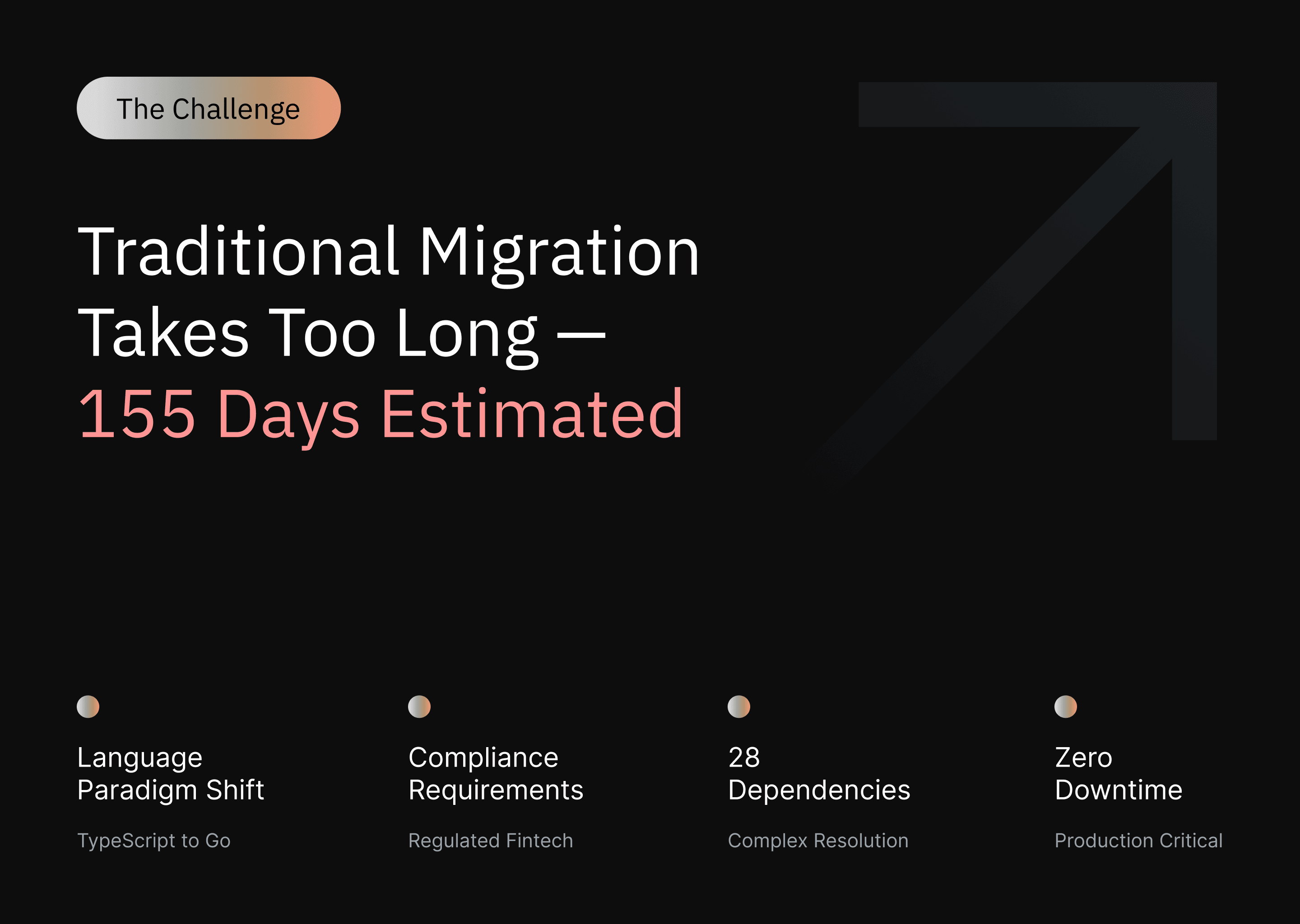
This migration presented multiple layers of complexity that would traditionally require months of senior developer time:
-Language Paradigm Shift: Moving from TypeScript's decorator-heavy, OOP patterns to Go's explicit, interface-based approach requires fundamental rethinking of code structure—not just syntax translation.
- Compliance Requirements: As a regulated fintech service, every change needed comprehensive audit logging, transaction traceability, and security documentation that would satisfy regulatory review.
- Dependency Maze: 28 npm packages needed Go equivalents. Some had direct replacements; others required complete reimplementation. Two internal shared packages (4,500+ lines) had to be ported from scratch.
- Integration Complexity: DataDog APM, Split.io feature flags, and multiple carrier-specific authentication flows all needed careful migration with zero downtime tolerance.
The Solution
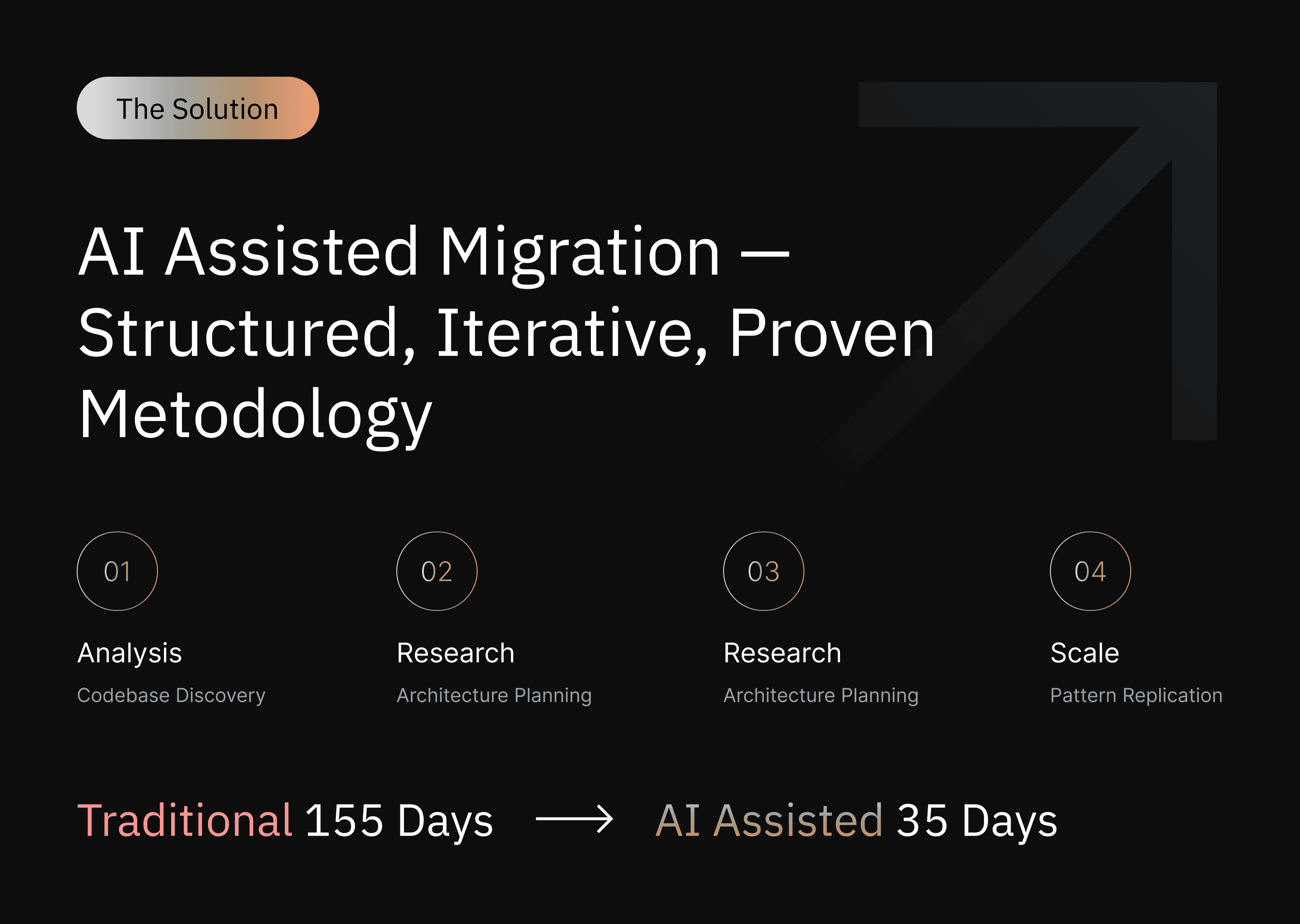
We applied Bloomteq's proven AI-assisted migration methodology—a structured, iterative approach refined across multiple enterprise engagements. This isn't just "using AI tools"; it's a systematic process supported by our proprietary accelerators:
Phase 1: Codebase Analysis & Discovery
We begin with deep analysis of the existing codebase using our internal scanning tools. This identifies architectural patterns, dependency relationships, code complexity hotspots, and migration risk areas. The output is a comprehensive migration map that guides all subsequent work.
Phase 2: Reference Architecture Research
Our team identifies reference codebases and industry best practices specific to the target stack. For this project, we analyzed production Go services in fintech, evaluated framework options (Echo, Gin, Chi), and documented patterns for compliance-critical applications. This research is captured in structured blueprints that feed our AI tooling.
Phase 3: POC Scope Selection
Rather than attempting full migration immediately, we select a representative proof-of-concept scope, typically 1-2 services that exercise the core patterns. For this project, we chose the carrier handler and bond pool service as our POC, covering database access, external API calls, and business logic.
Phase 4: POC Migration & Pattern Establishment
The POC phase establishes all foundational patterns: project structure, error handling, logging, testing approach, and CI/CD pipeline. This is the most human-intensive phase, with senior developers working alongside AI to craft idiomatic, production-quality code that becomes the template for everything that follows.
Phase 5: Results Analysis & Process Refinement
After POC completion, we analyze what worked and what didn't. Which prompts produced the best code? Where did AI struggle? What patterns need adjustment? These findings are incorporated into our migration accelerators, improving efficiency for the remaining codebase.
Phase 6: Scaled Migration with Pattern Replication
With patterns established and tooling refined, we scale to the full codebase. This is where AI delivers maximum value, replicating proven patterns across similar components with minimal human intervention. The 6 carrier services in this project were migrated in hours, not weeks.
Bloomteq's Proprietary Tooling
Our methodology is powered by internal tools developed through multiple migration engagements:
Migration Scanner: Analyzes source codebases to identify patterns, dependencies, and complexity metrics. Generates migration maps and risk assessments.
Blueprint Library: Curated collection of migration patterns, prompts, and reference implementations for common migration paths (NestJS→Go, React→Next.js, monolith→microservices, etc.).
Context Manager: Handles context window limitations across long migrations. Maintains architectural decisions, established patterns, and progress state across sessions.
Validation Suite: Automated comparison tools that verify migrated code maintains functional parity with the original, including API contract validation and behavior testing.
AI Foundation
These proprietary tools integrate with best-in-class AI models:
Claude Opus 4.6 for Research: Powers our research phase with architectural guidance, library comparisons, and best practice synthesis.
Claude Code for Implementation: Handles implementation with pattern-based code generation, test scaffolding, and documentation.
Human Oversight: Every generated artifact is reviewed by senior developers. AI accelerates; humans validate and ensure production quality.
Results: Time Savings by Phase
Research & Architecture Planning
| Manual (No AI) | AI-Assisted |
|---|---|
| 20.5 Days | 4 Days |
Time Saved: 80%
Framework evaluation. ORM selection, error handling patterns, middleware architecture, configuration design, and Architecture Decision Record (ADRs)
Dependency Resolution
| Manual (No AI) | AI-Assisted |
|---|---|
| 42 Days | 11.5 Days |
Time Saved: 73%
14 major dependency replacements including ORM, web framework, validation, logging, testing, configuration, and two complete internal package reimplementations.
Code Migration
| Manual (No AI) | AI-Assisted |
|---|---|
| 62.5 Days | 13.6 Days |
Time Saved: 81%
29 test files, 157 test functions. 59 table-driven test suites covering 450+ test cases.
Compliance Documentation
| Manual (No AI) | AI-Assisted |
|---|---|
| 11 Days | 2.3 Days |
Time Saved: 79%
5,571 lines of documentation including security controls, audit logging design, API documentation, deployment procedures, and migration guides.
Quality Comparison
| Quality Metric | Original (NestJS) | Migrated (Go) | Improvement |
|---|---|---|---|
| Test Cases | ~80 | 450+ | 5.6x more comprehensive |
| Test Coverage | ~60% | 65-75% | +8-25% |
| Documentation | ~500 lines | 5,571 lines | 11x more detailed |
| Security Controls | Basic | 15+ documented | Comprehensive |
| Table-Driven Tests | 0 | 59 suites | Go best practice |
The Pattern Multiplication Effect
| Pattern Type | First Instance | Remaining Instances | Effective Speedup |
|---|---|---|---|
| Carrier Handler (6 total) | 4 hours | 0.5 hours each | 3.7x |
| Service Tests (8 total) | 3 hours | 0.75 hours each | 5.8x |
| Enum Types (25 total) | 30 minutes | 5 minutes each | 10x |
After establishing one pattern, AI generates the remaining similar components in minutes rather than hours.
Total Project Summary
Overall Speedup
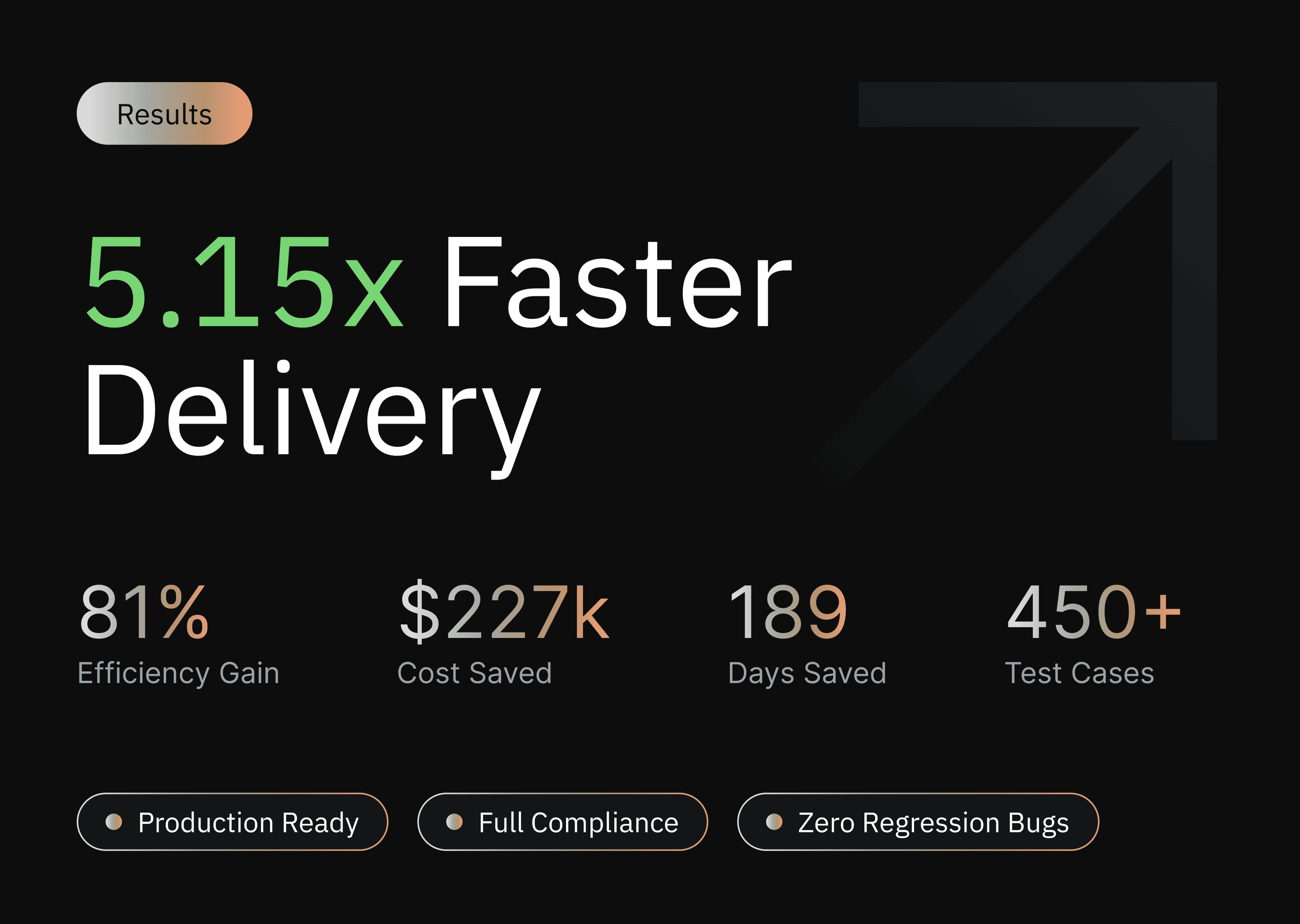
5.15x faster
81% efficiency gain
Time Comparison (Including Blockers & Rework)
| Metric | Manual Estimate | AI-Assisted Actual | Savings |
|---|---|---|---|
| Developer-Days | 234.5 | 45.5 | 189 days |
| Developer-Weeks | 47 | 9 | 38 weeks |
| Developer-Months | 10.7 | 2.1 | 8.6 months |
Cost Analysis (at $150/hour senior developer rate)
| Scenario | Hours | AI-Assisted Actual | Cost |
|---|---|---|---|
| Manual Migration | 1,876 | 364 | $281,400 |
| AI-Assisted | 364 | 72 | $54,600 |
| Savings | 1,512 hours | 16.8 | $226,800 |
Conclusion
Bloomteq's AI-assisted migration methodology delivered a 5.15x speedup with 81% time savings compared to traditional manual migration.
The migrated service is now in production with:
- Higher test coverage than the original
- More comprehensive documentation
- Full compliance audit trail
- Zero regression bugs in core functionality
This is not about replacing developers. It's about transforming migration work from months of repetitive translation into weeks of strategic architecture and validation.